Caccia Birch House is believed to have been built in 1895. Since then, it has been home to influential families, a Governor’s residence, a Victoria University education outpost, military barracks and a convalescent home.
It was originally designed by Danish architect (and former Mayor of Palmerston North) Ludolf Georg West, for Norwegian sawmiller Jacob Nannestad and his family.
In 1903, the property was bought by English businessman John Strang, who called it ‘Woodhey’. Strang was an affluent Englishman who had developed substantial business interests in Manawatū after his arrival in New Zealand. The family made major additions to the house to accommodate staff and added to the living area. On part of the property situated on the opposite side of the lagoon, they established a polo ground and John Strang and his brothers became founding members of the Manawatū Polo Club. In 1905, he added stables to the coach house for his horses.
In 1908, ‘Woodhey’ was leased to the Crown for Governor-General Lord Plunket and his family, before the Strang family returned from England in 1910.
In 1921, 'Woodhey' was purchased by William and Maud Caccia Birch, whose legacy lives on in naming the property Caccia Birch House. They lived here until William’s death in 1936. When Maud built a new home in Marton, she was unable to find a buyer for ‘Woodhey’, so the family then gifted the property to the Crown to be used in the war effort.
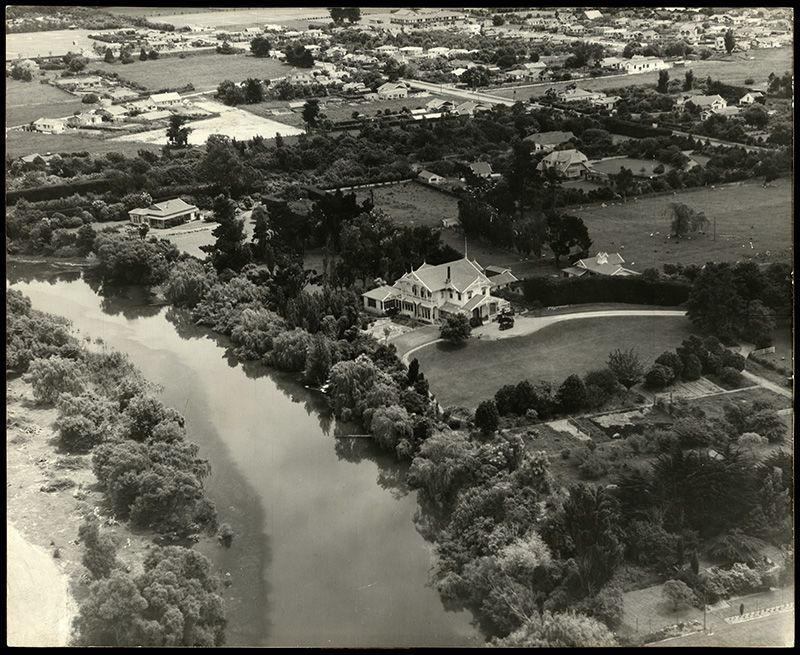 Oblique Aerial Photographs of Caccia Birch House, 1940 Manawatū Heritage
In 1941, the Army used the house as accommodation barracks for Home Guard Officers who were training at Massey. After the war finished, a veteran nurses’ convalescent home was established by the Palmerston North Hospital Board. It remained in use until the late 1950s.
In 1960, Victoria University set up offices and lecture rooms for a tertiary education outpost at Caccia Birch House. This was amalgamated with Massey Agricultural College in 1964 to become Massey University.
Without tenants from 1976, the house became derelict. In 1977, the Caccia Birch Preservation Society was formed with the intention of restoring the house. In an effort to retain Palmerston North history and with encouragement from the Preservation Society, Palmerston North City Council purchased the property in 1983 for 10c. By the early 1990s, the restoration had begun, with the work spread out over several years. It is listed as a Category 1 Historic Place with the NZ Historic Places Trust.
The Palmerston North City Council set up the Caccia Birch Trust Board with a deed that ensures the property is well preserved, maintained and available for use by the whole community. Caccia Birch House opened as a function centre in 1993 and has been successful in the conference, venue and weddings sector.
Visit the Coach House to explore the permanent historical display and uncover the fascinating stories of this Palmerston North treasure.
Caccia Birch House sits on land of deep cultural importance to Rangitāne o Manawatū, the mana whenua of the region. Rangitāne have lived in the Manawatū region for around 35 generations since the arrival of their ancestor Whātonga.
As a river people, Rangitāne built pā kāinga along the Manawatū Awa (river), between Te Apiti - Manawatū Gorge and the river mouth at present-day Foxton.
Swamps and lagoons were vital sources of food and resources and the area around Hokowhitu Lagoon was home to several pā.
From 1819, a succession of invasions from neighbouring and Waikato iwi had a devastating impact on Rangitāne.
Following a series of peace-making initiatives and a developing relationship with the Crown, Rangitāne paramount chief, Te Hirawanui Kaimokopuna, led the negotiations to transfer 250,000 acres of land to the Crown in 1864.
Named Te Ahu a Turanga, the block of land excluded several ‘Native Reserves’ located along the awa, one being the Hokowhitu Native Reserve. This area comprised 890 acres and was later subdivided in the Māori Land Court, with section 5 being where Caccia Birch House sits. All seven sections were sold in 1892-3.
Despite the loss of much of their land, Rangitāne maintained a presence in Hokowhitu, contributing to local economic activity and shaping the history of the site.